
Home EV Charger Installation in Dudley and the Black Country
A driveway charge point wired properly first time — correct earthing arrangement, dedicated protective device, and the paperwork sorted so you can plug in and forget about it.
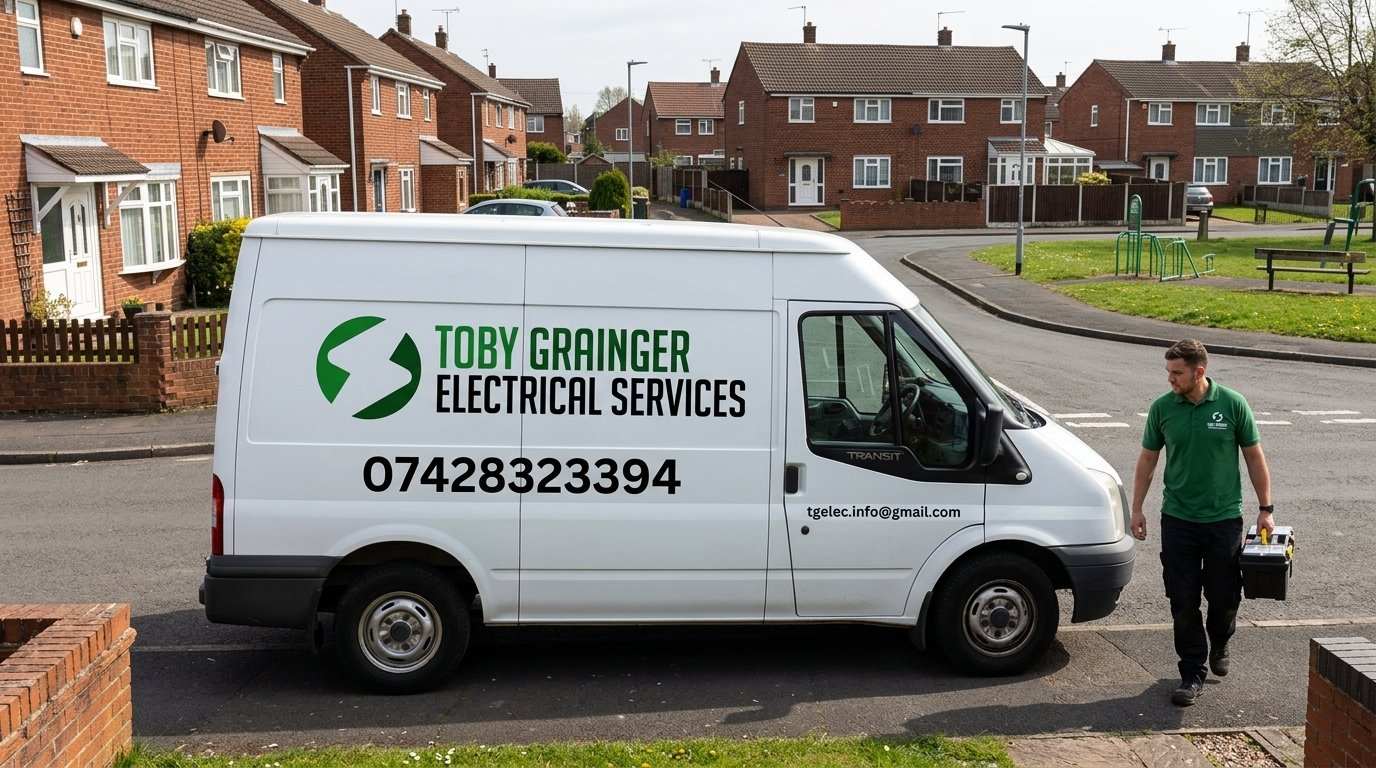
How a Home EV Charger Installation Works
A home EV charger is a dedicated circuit from your fuse box to the driveway, run in the right cable, protected by a 30mA RCD or RCBO, and installed with an earthing arrangement that satisfies BS 7671:2018 18th Edition. The work is notifiable under Part P Building Regulations, so it is certified and registered on completion.
Survey and earthing check
Before anything is quoted, the incoming supply, main earthing and bonding are checked, along with the spare capacity in your fuse box. Regulation 411.3.3 and the specific rules for charging equipment govern how the installation must be protected, and the earthing arrangement on your street decides whether an earth rod or a charger with built-in PEN fault detection is the right answer.
Cable route and load
Most Dudley driveways need a run from the consumer unit through the house or around the outside in SWA armoured cable with a proper gland at each end. Where the route crosses a garden or a shared drive, the trench depth, mechanical protection and cable size are all worked out before the first spade goes in.
Fitting the charge point
The unit is mounted at a sensible height for your parking position and cable length, sealed against weather, and fed by its own RCBO or 30mA RCD in the fuse box — never shared with sockets or lighting. Tethered and untethered units, 7kW single-phase, and load-limiting devices are all handled.
Testing, certification and notification
Every installation is tested and issued with a certificate covering the new circuit, and any alteration to the fuse box is documented. Notifiable work is registered so you have the Part P sign-off on file for your insurer, your energy supplier, and whoever buys the house next.
Handover and app setup
You get shown how the charger, its app and any scheduled off-peak charging actually work before the van leaves. If something looks wrong a week later, phone up — it gets looked at.
Why Use an Outdoor Specialist for Your Charge Point
EV chargers live outdoors, on a wall, in Black Country weather, on a circuit that pulls near its full rating for hours at a time. Toby Grainger Electrical works outdoors every day — armoured cable, IP-rated enclosures, weatherproof terminations and earthing — so the parts of the job that fail years later are the parts done properly.
Earthing done on your actual supply
The earthing arrangement is not assumed from the postcode. It is established on site, and the charger and protection specified to match, whether that means an earth electrode or an integrated PEN fault detection unit.
Weatherproofing that lasts
Glands, seals and cable entries are the first things to fail on a poorly fitted charger. Terminations are made to keep water out permanently, not just to pass the first wet week.
Honest answers about your fuse box
Some older Dudley boards genuinely cannot take another circuit safely. You will be told that up front, with the cost of a board change quoted separately, rather than having a charger squeezed onto tired gear.
Conservation area and tree awareness
In Dudley's conservation areas, including Mushroom Green, Love Lane and The Leasowes, trees with a trunk over 75mm are protected and the Council needs six weeks' written notice. Cable routes are planned around that, not through it.
Local, and easy to get hold of
One person, one van, one number. If you need the charger looked at, you speak to the electrician who fitted it, not a national call centre.
Tidy work on a lived-in driveway
Trenches are backfilled, block paving is lifted and relaid carefully, and dust sheets go down indoors. The drive is usable again the same day.
Where We Fit EV Chargers
Toby Grainger Electrical installs home EV charge points across Dudley and the surrounding Black Country, covering the borough and neighbouring towns. Most driveways within this area can be surveyed and quoted at no charge, with the installation usually completed in a single visit once the equipment is on site.
- Dudley Full coverage across Dudley town and the streets around Dudley Castle and Ednam Road, including terraced properties needing longer cable runs.
- Brierley Hill Charge points fitted throughout Brierley Hill, with extra care where the High Street Heritage Action Zone affects the front of a property.
- Sedgley Driveway and garage-side installations across Sedgley, including older properties needing an earthing check before quoting.
- Kingswinford Regular work across Kingswinford, where longer driveways often need armoured cable runs and careful charger positioning.
- Stourbridge Home charge points installed across Stourbridge, including load-limited setups on supplies already running electric showers.
- Halesowen Covered for surveys, installations and follow-up visits on existing chargers.
- Netherton and Woodside Local coverage for driveway and forecourt charge points on both new build and older housing.
- Coseley and Tipton Installations across Coseley and Tipton, including outbuilding and rear-access parking arrangements.
- Wordsley and Wall Heath Charge point fitting and fuse box upgrades throughout Wordsley and Wall Heath.
- Cradley Heath and Old Hill Covered for full installs, and for taking over chargers left half-finished by someone else.
EV Charger Questions We Get Asked
Most questions about home charge points come down to four things: whether your fuse box can take it, how far the cable has to run, whether the job needs notifying, and how long the driveway is out of action. Straight answers to each are below, and anything else can be settled on a phone call.
How much does it cost to have an EV charger fitted?
The charger unit and a short, straightforward run are the cheapest scenario; cost climbs with cable distance, trenching, and whether your fuse box needs work first. Because the earthing arrangement and board capacity vary house to house in Dudley, a fixed price only comes after a look at the supply. Surveys and quotations are free and there is no obligation.
Do I need to tell anyone that a charge point has been installed?
Yes. Installing a charge point circuit is notifiable work under Part P Building Regulations, so it must be certified and registered — that is handled for you as part of the job. Your energy supplier and the network operator may also need notifying depending on the charger rating, which is dealt with at the same time.
How long does the installation take?
A typical single-phase home charger with a reasonable cable route is a one-day job. Add a trench across a lawn or driveway, a fuse box replacement, or a long run through the house and it can stretch into a second day. You will be told which it is before booking, not on the morning.
Can my old fuse box handle an EV charger?
Sometimes, but not always. The charge point needs its own way with a 30mA RCD or RCBO, and many older boards have no spare capacity or lack the required protection. The board is inspected during the survey and, if it needs replacing, that is quoted separately so you can see exactly what you are paying for.
What if there is no off-street parking at my property?
A home charge point has to be installed so the cable does not cross a public footpath, so a driveway, forecourt or garage access is needed. If you have rear or shared access it is often still workable — send a photo to tgelec.info@gmail.com and it can usually be assessed before a visit.
Will you dig up my driveway to run the cable?
Only where there is no better route. Wherever possible the cable runs along walls or through the property in armoured cable rather than under block paving. If a trench is unavoidable, the depth and protection are done to standard and the surface is reinstated as found.
Can you take over an installation someone else has started?
Yes. If a charger has been left unfinished, untested or without certification, the existing work is inspected first and you are told plainly what can be kept and what has to be redone. Nothing gets signed off that has not been tested properly.
Home EV Charger Installation in Dudley and the Black Country
A driveway charge point wired properly first time — correct earthing arrangement, dedicated protective device, and the paperwork sorted so you can plug in and forget about it.
Contact Toby Grainger Electrical
- Phone 07428323394
- Email tgelec.info@gmail.com
- Serving Dudley and the surrounding Black Country area