
Shed, Garage & Outbuilding Power Supply in Dudley
A proper buried SWA armoured supply and its own small fuse box in the building — so your shed, garage or garden room has light, sockets and heat that lasts for decades.
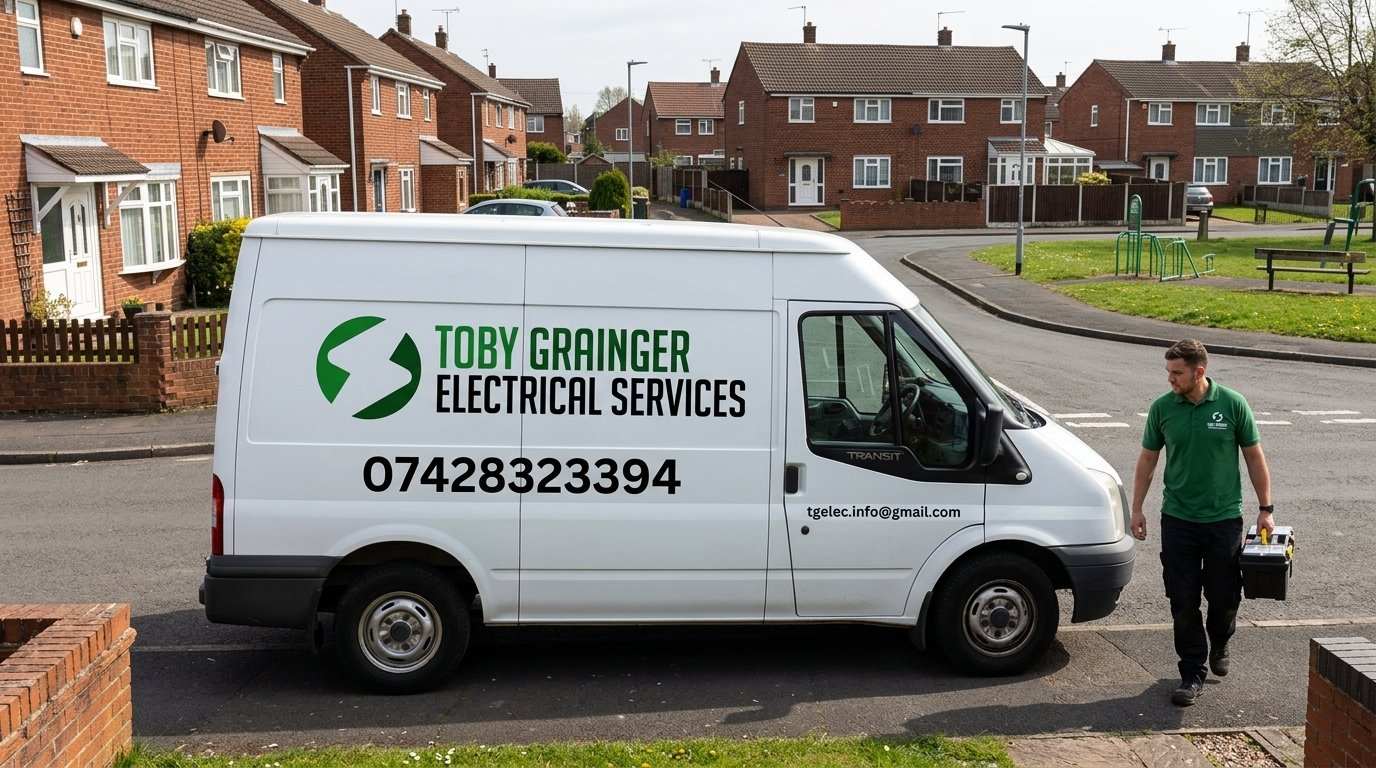
How an outbuilding supply is installed
A permanent outbuilding supply means a dedicated circuit from your house fuse box, steel wire armoured cable buried at depth or clipped along a safe route, glanded into a small sub-board in the outbuilding, then lighting and socket circuits run from there. Work is tested and certified to BS 7671:2018 18th Edition and notified under Part P Building Regulations.
Survey and cable route
We walk the run with you from the fuse box to the building, measure the distance and agree where the trench or clipped route goes. Length matters — a long run needs a larger cable size to keep voltage drop and fault protection within the limits set by BS 7671, including the disconnection times in Regulation 411.3.3.
Supply at the house end
Most homes need a new way added at the existing consumer unit, usually an RCBO so a fault in the shed cannot trip the house. Where the existing fuse box is full, obsolete or has no 30mA RCD protection, we will tell you honestly before you commit and quote the options separately.
SWA armoured cable and trenching
SWA is the right cable for a garden because the steel armour takes the mechanical knocks and the sheath survives being buried. Cable buried in the ground goes in a trench at a sensible depth with warning tape above it; where digging is not practical we look at routing along a wall or fence line instead.
Cable glands and terminations
Each end is terminated with a proper cable gland that grips the armour and earths it, then sealed against water. This is the part that quietly fails on DIY jobs — a bodged gland lets moisture track down the cable and corrodes the whole run from the inside.
Sub-board, lighting and sockets
Inside the building we fit a small distribution board with 30mA RCD protection, then split light and power onto separate circuits. From there it is your call: LED strips and a switch for a workshop, sockets for freezers, tools or a garden office, or outside lights on the building wall.
Testing and paperwork
The new circuit is tested, results recorded, and you get certification for the work along with a Minor Works Certificate or full certificate as appropriate. If you are selling later, or your insurer asks, that paperwork and any supporting EICR is what proves the job was done properly.
What makes this job go smoothly
Outbuilding supplies go wrong for predictable reasons: undersized cable, no earthing of the armour, a shed board with no RCD, or a trench dug straight through a protected tree root plate. Toby Grainger Electrical plans the route and the cable size before a spade goes in the ground.
One person, start to finish
The same electrician quotes it, digs it, terminates it and tests it. You are not handed between a salesman and a subcontractor, and you have a mobile number that answers afterwards.
Honest about the trench
Digging is the slow, dirty part of the job and we say so upfront. If you want to dig the trench yourself to save money, we will mark the route, give you the depth and inspect it before the cable goes in.
Conservation areas and trees taken seriously
Dudley borough has 22 conservation areas, with tighter controls in places like Mushroom Green, Love Lane and The Leasowes. Trees over 75mm trunk diameter are protected there and the Council needs six weeks' written notice, so we route cables around root protection zones rather than risk an enforcement problem for you.
Sized for what you will actually plug in
A shed with two LED lights and a phone charger is a different cable to a garage with a welder, a car lift or a garden room running heating year round. We ask what the building is really for, including anything you plan to add later.
Tidy reinstatement
Turf lifted carefully and put back, block paving relaid, spoil taken away rather than left in a heap by the back door. Neighbours in terraced streets get told what is happening before the noise starts.
Areas covered for outbuilding supplies
Toby Grainger Electrical installs shed, garage and garden room supplies across Dudley in the West Midlands and the surrounding Black Country. Coverage includes long garden runs, shared driveways and terraced properties where the cable route needs planning rather than guessing. Call 07428323394 to check your street.
- Dudley Full coverage across Dudley town and the surrounding estates, including older properties near Dudley Castle and Ednam Road where fuse boards often need attention first.
- Brierley Hill Garage and workshop supplies throughout Brierley Hill, with care taken around the High Street Heritage Action Zone and its additional controls.
- Kingswinford Popular for garden rooms and home offices on longer plots, where cable sizing for the distance is the main decision.
- Stourbridge Detached garages and studio buildings, including runs that cross driveways and need ducting under block paving.
- Halesowen Sloping gardens and stepped plots where the trench route needs walking properly before it is priced.
- Sedgley and Coseley Sheds, workshops and hobby garages on established streets, with sub-boards fitted inside the building rather than extension leads out the window.
- Netherton and Woodside Terraced and semi-detached homes where access is through the house or an entry, planned in advance so nothing gets carried over your carpet.
- Cradley Heath and Old Hill Garage conversions and outbuilding upgrades, including replacing old unearthed twin and earth runs with proper SWA.
Common questions about shed and garage power
Most people ask about price, digging, timescale and whether the job needs signing off. A typical single-circuit shed supply is a one-day job; a long run with a trench and a sub-board can take two. Everything is quoted in writing before any work starts, with no obligation.
How much does it cost to run power to a shed or garage?
The price depends almost entirely on the cable run length, the cable size needed and whether the trench is dug by hand through lawn, roots or block paving. The other variable is your existing fuse box — if there is no spare way or no 30mA RCD protection, that is an extra to budget for. We quote a fixed price after seeing the route, free and with no obligation.
Can I use an extension lead to my shed instead?
An extension lead trailing across the garden is fine for an hour with a hedge trimmer, not as a permanent supply. It is a trip hazard, it degrades in sunlight and damp, and it gives you no fault protection or isolation at the building. A buried SWA circuit with its own board is the safe, permanent answer.
Do I need building regulations approval or planning permission?
You do not need planning permission for the electrics themselves, but a new circuit to an outbuilding is notifiable work under Part P Building Regulations and must be certified. We handle that notification. If the trench passes near a protected tree in one of Dudley's conservation areas, the Council also needs six weeks' written notice, which we will flag at the quote stage.
How deep does the cable have to be buried?
Buried SWA needs to be deep enough to be clear of normal garden digging, with warning tape laid above it so anyone excavating later finds the tape first. Under drives and paths it goes deeper or into a duct. We agree the exact depth and route on site, because roots, drains and existing services all affect it.
Do you dig the trench, or do I?
Either works. We can dig and reinstate the whole run, or you can dig it yourself to save on labour — in which case we mark the route, tell you the depth and width, and inspect it before laying cable. Do not backfill before we have seen it.
How long will the power be off in the house?
Only for the short period while the new way is added at the fuse box and tested, usually well under an hour. We tell you when it is coming so you can shut down computers or move anything out of the freezer, and we work around home workers and young children's nap times where we can.
Can you add power to a garden room I have already had built?
Yes, and it is very common. We work with whatever cladding and construction is there, run the cable in as discreetly as possible, and fit the sub-board, lighting and sockets inside without disturbing the finish. Email tgelec.info@gmail.com with a photo of the building and the house end and we can give you an idea before visiting.
Shed, Garage & Outbuilding Power Supply in Dudley
A proper buried SWA armoured supply and its own small fuse box in the building — so your shed, garage or garden room has light, sockets and heat that lasts for decades.
Contact Toby Grainger Electrical
- Phone 07428323394
- Email tgelec.info@gmail.com
- Serving Dudley and the surrounding Black Country area